Databilgilerinden bir devre şeması
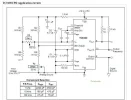
TC9400 Voltage to Frequency converter (Single supply version)
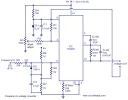
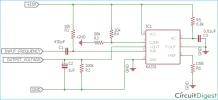
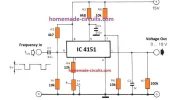
In the circuit shown above the TC9400 is wired as a F to V converter that operates from a single supply. The circuit generates an output voltage that is proportional to the input frequency. The input frequency is applied to the pin11 (non inverting input of the internal comparator). In order to trip the comparator the amplitude of the input frequency must be greater than +/-200mV.Below this level the circuit will not work at any situation.
Whenever the input signal to the pin 11 of IC1 crosses zero to the negative direction the output of the internal comparator goes low. The 3uS delay circuit enables the C
ref charge/discharge circuit after 3uS and this connects the C
ref to the reference voltage and this charges the integrating capacitor C
int a specific amount of voltage. In the single supply operation the reference voltage is the potential difference between pin 2 and 7 of the TC9400. Each time the input frequency wave form crosses zero towards positive direction, the output of the internal comparator goes high and this disables the C
ref charge/discharge circuit which creates a short circuit across the C
ref leads. The voltage across the integrating capacitor C
int is retained because the only discharge path available is the 1M resistor R
int which is a too high and the voltage across C
int is the output voltage. Resistor R
biasis used to set the bias current of the IC.
The potential divider network comprising of R6 and R7 makes sure that the input threshold tracks the supply voltage always. The clamp circuit using diode D2 prevents the input from going far negative in order to turn on the internal comparator. In simple words this section of the circuit can be generally termed as a level shifter.
The TC9400 manufacturers claim that it can accept a signal of any frequency at its input. In the practical side, for the proper working of this circuit the positive half of the input signal must have at least 5uS pulse width and for the negative half it must be greater than or equal to 5uS.
For calibration adjust the offset adjust trimpot to obtain 0V at the output with no input frequency applied. If you have a function generator, set frequency input to 10KHz and make adjustments in the value of C
ref to get around 2.5 to 3 volts at the output. This calibration is meant for a maximum input frequency of 10KHz.
Notes.
- The circuit can be assembled on a Perf board or PCB.
- The circuit can be powered from anything between 10 to 15V DC.
- R3 can be used for adjusting the offset voltage.
- In the circuit the inverting input of the internal comparator is referenced to 6.2V by using D1. So the input signals amplitude must be between 4V and the supply voltage (V+).
- The output voltage is also referenced to 6.2V in this circuit.
- The output voltage and input frequency of the F to V converter is related using the equation V out = V ref x C ref x F in where V out is the output voltage and F in is the input frequency.
- TC9400 and TL071 must be mounted on holders.