

Background
The initial application for this circuit was a reset timer in which the output was hard-wired across a reset pushbutton. The terminology is a little confusing because this is a reset timer that resets digital electronics, and the timer itself must reset instantly upon power loss by dumping the charge in the timing capacitor.
When digital components (including some Bluetooth stuff) are interconnected in automotive applications, initialization is sometimes an annoying problem that is complicated if both pieces of equipment do not have the same reset criteria (e.g. one component resets upon complete power loss, while another component resets when Vcc drops only briefly or slightly). In this application, a 50sec reset duration was found to be effective (I cannot provide more information because I was helping someone of a different language in a distant country).
More advanced software features provide a warm reset feature that automatically restores lost communications in such a case, a reset timer is not required.
Schematic
Circuit Function
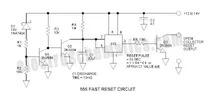
The 10V threshold is basically the drop of zener D1 and the base to emitter junction voltage of Q1. If a lower voltage is desired, a 9.1V, 8.2V or other zener may be used instead. When the voltage dips, the zener immediately stops conducting, Q1 turns off and the bias current through R3 (approx 1mA) is then diverted to the base of Q2. Q2 has an hFE of 60 @ 50mA, so its collector current will be a minimum of approx 60mA. The 47µf timing capacitor is discharged at this current and is fully discharged in less than 10mS. Note that it is discharged well before the 12V supply fully collapses. Note also that when Q2 turns on, the reset output function begins immediately and is completed 50sec after Vcc is restored. Of course, the reset output period may be adjusted per your requirements simply by adjusting the capacitor value.
The initial application for this circuit was a reset timer in which the output was hard-wired across a reset pushbutton. The terminology is a little confusing because this is a reset timer that resets digital electronics, and the timer itself must reset instantly upon power loss by dumping the charge in the timing capacitor.
When digital components (including some Bluetooth stuff) are interconnected in automotive applications, initialization is sometimes an annoying problem that is complicated if both pieces of equipment do not have the same reset criteria (e.g. one component resets upon complete power loss, while another component resets when Vcc drops only briefly or slightly). In this application, a 50sec reset duration was found to be effective (I cannot provide more information because I was helping someone of a different language in a distant country).
More advanced software features provide a warm reset feature that automatically restores lost communications in such a case, a reset timer is not required.
Schematic
Circuit Function
The 10V threshold is basically the drop of zener D1 and the base to emitter junction voltage of Q1. If a lower voltage is desired, a 9.1V, 8.2V or other zener may be used instead. When the voltage dips, the zener immediately stops conducting, Q1 turns off and the bias current through R3 (approx 1mA) is then diverted to the base of Q2. Q2 has an hFE of 60 @ 50mA, so its collector current will be a minimum of approx 60mA. The 47µf timing capacitor is discharged at this current and is fully discharged in less than 10mS. Note that it is discharged well before the 12V supply fully collapses. Note also that when Q2 turns on, the reset output function begins immediately and is completed 50sec after Vcc is restored. Of course, the reset output period may be adjusted per your requirements simply by adjusting the capacitor value.
Son düzenleme:
