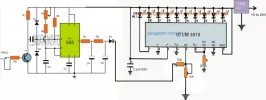
This situation allows the user to set the response pattern of the output.
The output triggering of the IC 555 is further smoothened by an integrator stage using R7/R8 and C4/C5.
The integrated or smothened output is applied to a 10 step dot/bar LED driver LM3915 circuit stage.
The processed frequency to voltage conversion from the IC 555 tachometer circuit is appropriately displayed across the 10 LEDs associated with the LM3915 IC.
Since pin#9 of the IC is attached with the positive rail, the LED displays a bar mode pattern of the frequency level or the RPM level of the connected engine.
The 10 LED bar graph ascend or descend their illumination in response to the frequency levels from the automobile engine and allow the circuit to be used like an effective 10 LED tachometer.
Parts list for the IC 555 section
Parts List- R1 = 4K7
- R3 = CAN BE VARIABLE 100K POT
- R4 = 3K3,
- R5 = 10K,
- R6 = 470K,
- R7 = 1K,
- R8 = 10K,
- C1 = 1uF,
- C2 = 100n,
- C3 = 100n,
- C4 = 22uF/25V,
- C5 = 2.2uF/25V
- T1 = BC547
- IC1 = 555,
- D1, D2, D3 = 1N4148
Using only LM3915
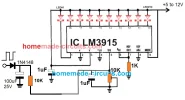
A closer inspection of the above circuit reveals that the IC 555 stage is actually not required and seems like an overkill for the purpose.The main concept here is to convert the frequencies into an average DC whose level would be proportionate to the input frequency level. This implies that a simple diode, resistor, capacitor network would be enough to accomplish this action.
Also called an integrator, this small circuit network could be integrated with the LM3915 for ensuring that the voltage level stored in the capacitor is proportionately varied depending on the frequency levels.
Faster frequencies would allow the capacitor to charge and hold the DC proportionately better resulting in a higher average DC output and vice versa. This would in turn produce an equivalent level of LED illuminations on the LEDs attached with LM3915 output.
Here's the simplified version of the 10 LED tachometer using just a single IC M3915.
Circuit Operation
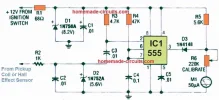
The circuit diagram shows a simple configuration utilizing the IC 555. The IC is basically configured as a monstable multivibrator.The pulse is derived from the spark plug and fed to the end of R6.
The transistor responds to the pulses and conduct in accordance with triggers.
The transistor activates the monostable with every rising pulse of the input.
The monostable stays ON for a particular moment each time its triggered and generates an average ON time at the output which is directly proportional to the average trigger rate.
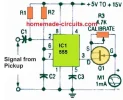
The capacitor and the resistor at the output of the IC integrate the result so that it can be directly read over a 10V FSD voltmeter.
The pot R3 should be adjusted such that the output generates the exact interpretations of the fed RPM rates.
The above setting up must be done with the help of a good conventional tachometer unit.
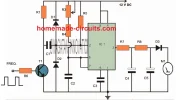
Parts List
R1 = 4K7R2 = 47E
R3 = CAN BE VARIABLE 100K POT
R4 = 3K3,
R5 = 10K,
R6 = 470K,
R7 = 1K,
R8 = 10K,
R9 = 100K,
C1 = 1uF/25V,
C2 = 100nF,
C3 = 100n,
C4 = 33uF/25V,
T1 = BC547
IC1 = 555,
M1 = 10V FSD meter,
D1, D2 = 1N4148